



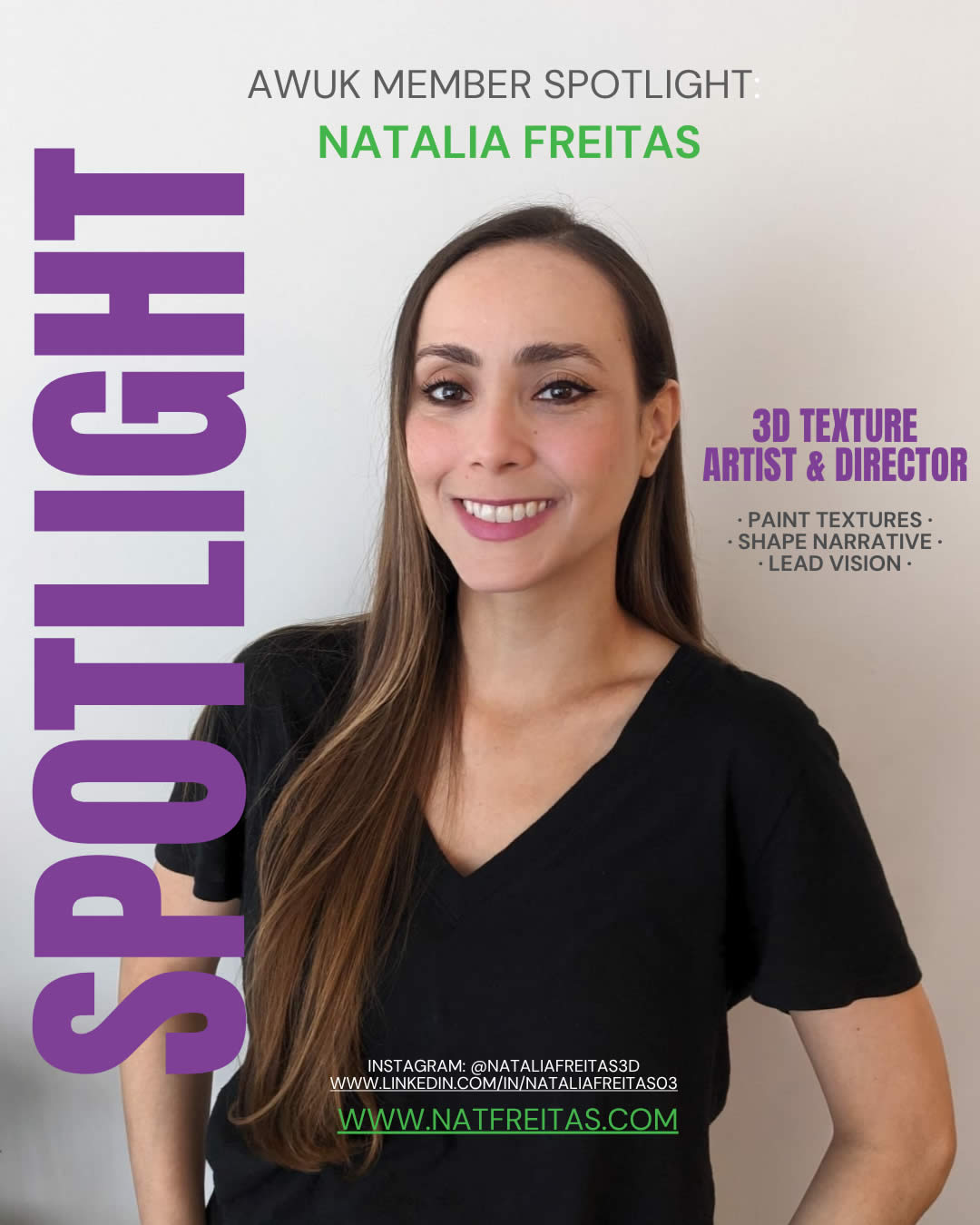
I'm Natalia Freitas, director and 3D artist, currently working at DNEG Animation as a Surfacing Artist.
Art was and still is my biggest emotional support. I lost my parents when I was ten years old and listening to music, watching films, cartoons, playing video games, drawing and reading comics helped me escape my reality. When I became a teenager, I knew that I wanted to pursue a career as an artist and that's what I did. Thanks to my work, I had the opportunity to experience different cultures and meet a lot of artists from different backgrounds. I started my career in my home country in Brazil, then in 2012 I got a scholarship to do a postgraduate degree in Germany. In 2016 I got a job in the USA, then Canada, then back to the USA and now in the UK. I am grateful for all the adventures abroad.
As a director, during the pre-production phase, there is a lot of work reviewing and sometimes rewriting scripts, working together with concept and storyboard artists, preparing the animatic, giving feedback to the voice over actors, the music team and making sure that everything is ready for production. And during the production phase, a lot of daily meetings are necessary to review, give feedback and approve the work of all the departments until the conclusion of the project. This stage is only made possible with the work and involvement of all the project coordinators and producers.
As a Surfacing Artist, I have a lot of fun painting the texture maps, creating the hair and fur when necessary, developing the materials and applying the proper look to the grey 3D models.
As a director, it's important to understand what each department does and also understand the production's limitations, so we don't exceed the budget and the schedule with multiple feedback.
As a Surfacing Artist, following a briefing is very important. Of course there is room for your own creative input, but understanding what the client wants and achieving the right look for the assets are fundamental during production.
I use many software everyday. When I am painting the texture maps, I usually work either with MARI, Substance Painter or Substance Designer. If I am doing the hair/fur, I do the grooming work in Houdini or Maya/Xgen. And then for the final look, I use Katana to create the proper shading and refine the materials. All these tools I've learned by practicing in the course of the work.
It's amazing to be part of the creative process and see the project being developed. I also love that I can contribute as an artist to something that will entertain other people. During covid, if it wasn't for films, animations, games, books, we would be lonely and bored. Art is a great companion, especially for those making it.
Some people think that Surfacing Artists just colour the 3D models, but what we do involves other steps as well. It's a job that is both artistic and technical.
As a foreign/Brazilian woman working abroad, one of the main challenges is to break the stereotype. Sometimes people underestimate me, not only for my gender but also for my accent or the colour of my skin. I sometimes find I have to confront assumptions regarding my capability and I need to work harder to prove my worth and be taken seriously.
When I started my career path, I thought that to work in animation I had to be an animator. So, I dedicated 6 years of my life studying and working as a traditional 2D Animator. Then, when I started learning 3D in 2011, I thought that I had to be a 3D generalist, doing everything. Later, I've learned that, to work in the film industry, it's important to focus in one area and be exceptional in what you do. If I had known that before, I would have specialized much sooner.
I honestly sometimes struggle with this. I love what I do and I am constantly pushing myself to do better. Quite often, my husband needs to remind me to log off when the day is done. And when I am not on the computer, you will find me either doing some traditional art (sculpting, drawing, painting) or in the kitchen cooking and baking.
That animation is just for kids. There are many animations that I used to watch when I was a kid that had more impact on me when I rewatched as an adult. I also believe it shouldn't be limited to family friendly audiences. There are many animations done for adults that are fantastic.
This site uses Cookies to ensure the best experience. By continuing to use this website you agree to their use. To learn more please visit our Privacy Policy.